Worldwide innovation awards
Celebrating the leaders in cyber resilience
In the opening paragraphs of his 1482 letter to Ludovico Sforza, Leonardo da Vinci offered his services not as a painter but as a military engineer. His case was built on defense and countermeasures: how to break a siege, how to protect a position, how to keep a city standing when it came under pressure. Two decades later he put that expertise to work as a fortifications engineer, inspecting strongholds across Romagna and sketching new defensive designs.
His central problem was one that every military engineer of the period had to face. Gunpowder artillery had made the tall, thin medieval curtain wall dangerously obsolete. A wall built to resist an assault by men with ladders would shatter under cannon fire, and once breached, the whole defense failed at once. Leonardo’s studies point toward a different philosophy: low, thick, rounded bastions that deflected incoming force rather than absorbing it head-on, and overlapping fields of fire so that no single point of failure could undo the whole. The new fortress did not assume the attacker would be kept out. It assumed pressure would arrive, and it was engineered to survive it.
That shift, from a defense built around prevention to a design built around survival, is the foundation of cyber resilience. The perimeter-focused security model, with a strong wall and a trusted interior, has met the same fate as the medieval curtain wall. Attackers breach perimeters, credentials are stolen, suppliers are compromised and systems fail for reasons that have nothing to do with adversaries at all. The question that matters is no longer only “can we keep them out?” but “when something gets in, or something breaks, how quickly do we detect it, contain it and recover?”
The DaVinci Awards® Cyber Resilience category recognizes the organizations building the answers.
Worldwide innovation awards
how have you excelled?
Cyber resilience has emerged as a distinct discipline over the past several years, as the limits of prevention-only security became impossible to ignore. Ransomware has turned data recovery from an IT housekeeping task into a boardroom-level continuity question. Regulators have responded: frameworks such as the EU’s Digital Operational Resilience Act (DORA) and the NIS2 Directive now demand that organizations demonstrate not just security controls but the ability to withstand and recover from disruption. Software supply chains have introduced dependencies that no single organization can fully inspect. And the shift to cloud, hybrid and distributed infrastructure has multiplied the surfaces that must be monitored, protected and, when necessary, rebuilt.
The DaVinci Awards® recognizes the full breadth of innovation this has produced. At the preparation end: the platforms that map attack surfaces, quantify cyber risk, validate controls and rehearse crisis response before a real incident tests them. At the detection and response end: the systems that identify intrusions early, correlate signals across sprawling environments, automate containment and accelerate investigation. At the recovery end: the backup, immutability, orchestration and clean-room technologies that restore operations quickly and with confidence that what is being restored is itself trustworthy. And at the foundation: the identity, access and architecture approaches, from zero trust to secure-by-design engineering, that limit how far any single failure can spread.
Entries are welcomed from security vendors at any scale: startups introducing genuinely new approaches to detection, recovery or risk; established platforms deploying AI to change what their products can do; and specialist tools that solve one critical resilience problem exceptionally well, from immutable backup verification to operational technology monitoring in industrial environments.
If your product helps organizations withstand disruption, recover faster and keep operating when it matters most, a DaVinci Award® could be yours.

Worldwide innovation awards
Areas of Interest
The DaVinci Awards® recognizes outstanding feats of human ingenuity and product innovation in cyber resilience. Entries are welcomed from individuals, teams, startups and established enterprises based anywhere in the world. Areas of interest include, but are certainly not limited to:

Impress the judges
Ingenuity of Approach
Cyber resilience sits at the intersection of security engineering, infrastructure architecture, data science and organizational risk, and the DaVinci Awards® panel assesses submissions across that full breadth. Show the thinking behind your innovation: what resilience failure or gap was addressed, why existing approaches left it unsolved, and what technical or design decisions produced your solution. The most compelling entries address the underlying difficulty of the problem rather than its symptoms: the untested recovery plan that fails under real conditions rather than merely the slow backup job, the blind spot between identity systems that attackers exploit rather than merely the noisy alert queue, the uncertainty over whether restored data is clean rather than merely the restore speed. Entries that demonstrate a distinctive and well-reasoned theory of how organizations fail under attack, and how their product changes that outcome, will score most strongly on this criterion. The panel is particularly attentive to AI-powered claims, which are now widespread: submissions that can demonstrate measurable improvements in detection accuracy, response time or recovery reliability, rather than simply the presence of AI in the product, will be assessed most favorably.
Impress the judges
The Problem Solved
Cyber resilience technology exists to reduce the damage and duration of disruption, and the DaVinci Awards® assesses it on that basis. Clearly explain the resilience challenge your product addresses, the organizations or environments it serves, and the measurable improvement it delivers. Quantified outcomes strengthen a submission significantly: reduction in mean time to detect or contain, improvement in verified recovery time against defined objectives, increase in the proportion of critical systems covered by tested recovery plans, reduction in exploitable exposure over time, or equivalent metrics appropriate to your product’s function. Evidence from real incidents, tested recoveries or independent validation carries far more weight than vendor-defined benchmarks, and the panel looks favorably on candor about where a product’s limits lie. Judges are also attentive to operational reality: a resilience tool that demands specialist expertise most organizations cannot staff, or that adds more alert fatigue than it removes, delivers less practical value than its feature list suggests. Where your product serves regulated or safety-critical environments, address how it supports compliance obligations without reducing resilience to a checklist exercise.

Impress the judges
Scalability & Legacy
Resilience challenges scale unevenly: a small organization with a single cloud tenant and a global enterprise with thousands of interdependent systems face problems that are different in kind, not just degree. Describe your product’s current deployment scope: the size and type of organizations served, the complexity of environments supported and the geographies covered. Explain how your approach scales, technically and operationally, and what investment has been made in integration with the broader security and IT operations stack, since resilience tools that cannot work alongside existing infrastructure rarely achieve lasting adoption. For platforms and analytics products, describe the data and threat intelligence underpinning your models and how performance has been validated across different environments and attack types. The DaVinci Awards® is most interested in cyber resilience innovations with durable influence: the recovery architecture that becomes the standard for how organizations protect critical data, the detection approach that changes how security teams find intrusions, or the validation platform that lastingly shifts organizations from hoping their defenses will hold to knowing how they will perform under pressure.
Winners’ rewards
Promoting your success
Winners may make full use of The DaVinci Awards® hallmark of excellence, linked to your level of accreditation, on all relevant materials.
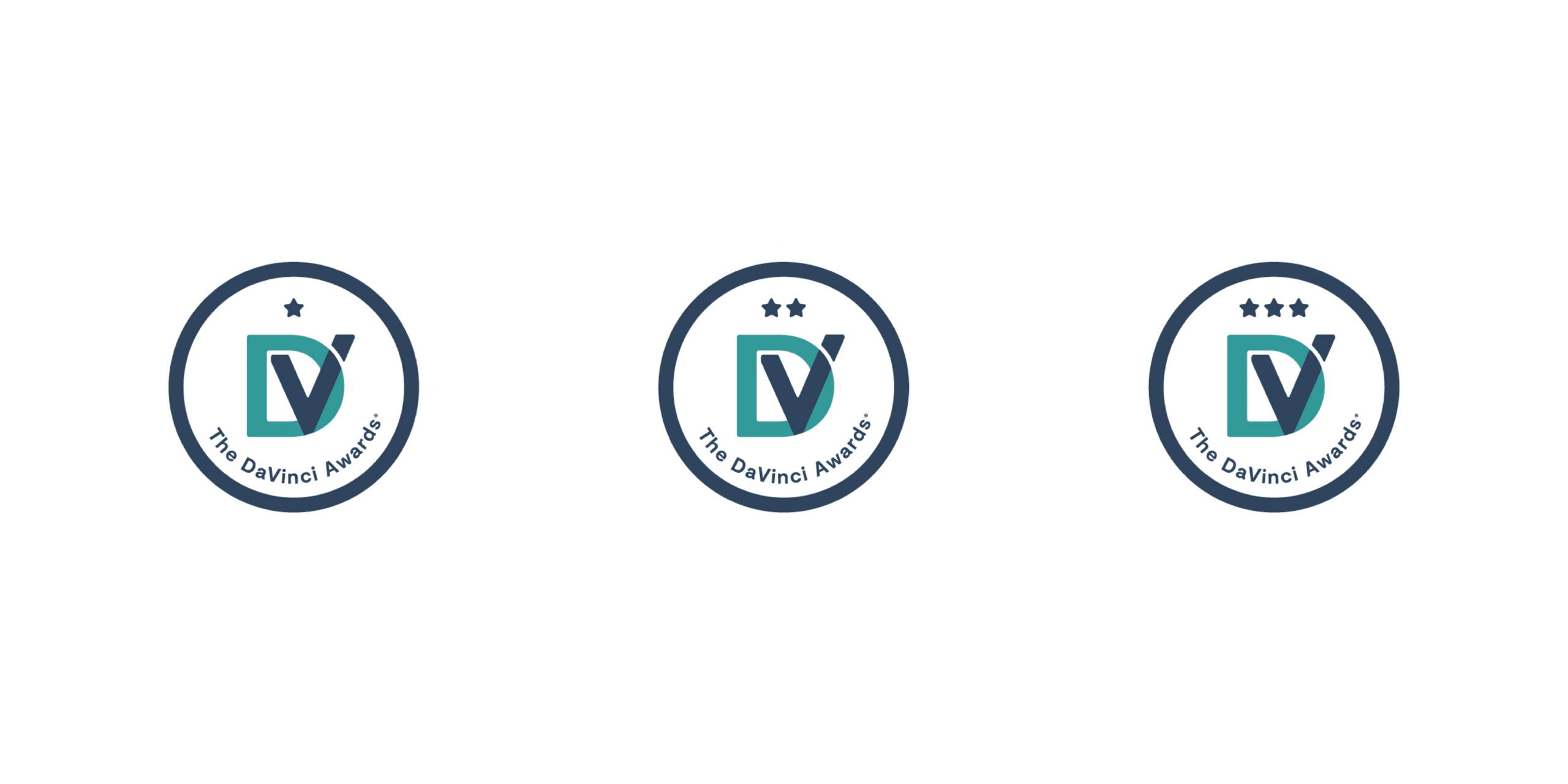


All winners also receive a DaVinci Awards® trophy, and substantial press opportunities working in partnership with our editorial team. Find out more.