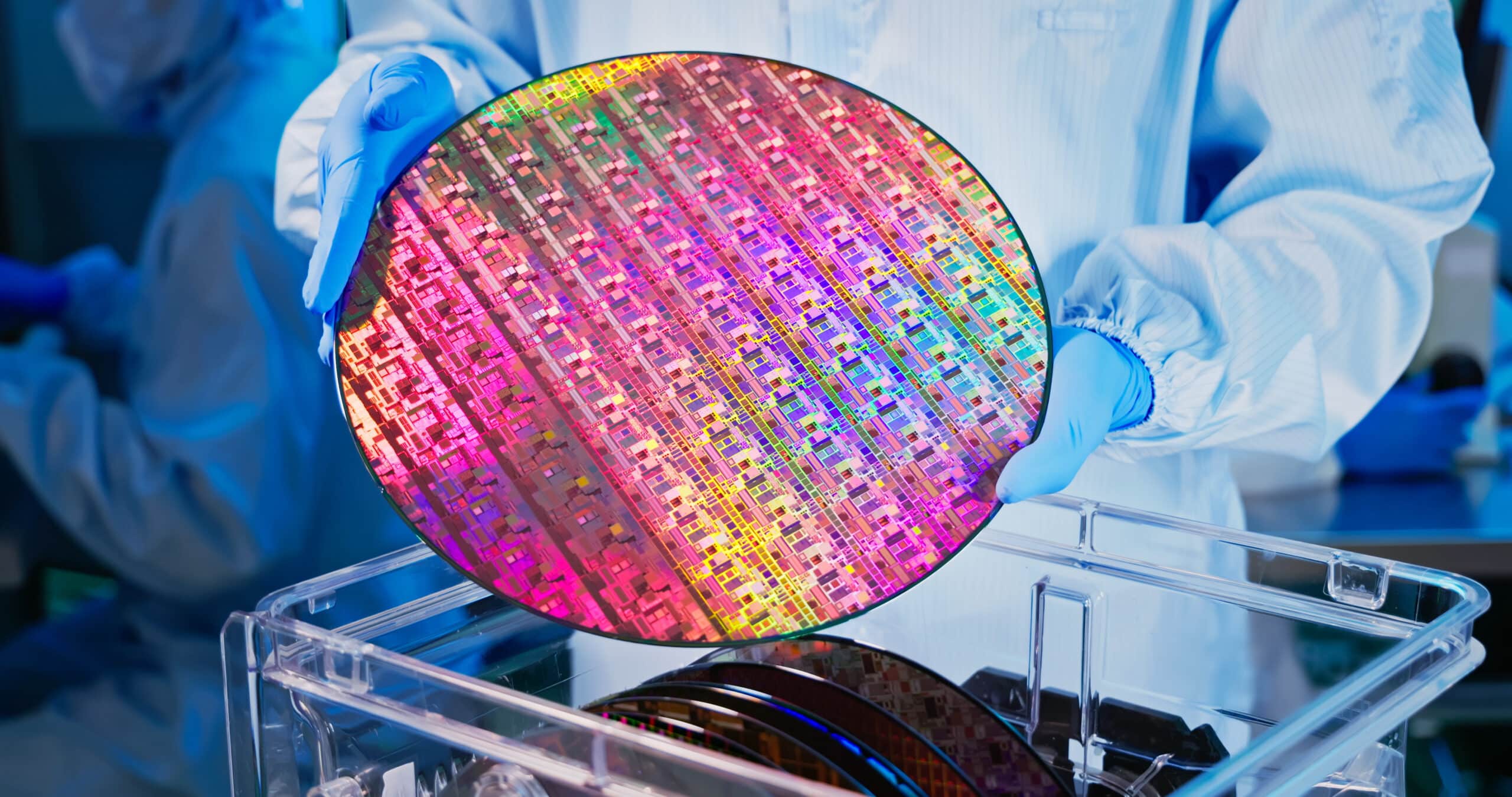
Worldwide Computing & Semiconductor Hardware Awards
Celebrating the leaders in computing and semiconductor hardware
In the 1490s, Leonardo da Vinci designed an adding machine: a mechanical calculator built from interlocking gear wheels, arranged so that a full rotation of one wheel advanced the next by a single increment, carrying arithmetic through the mechanism the way a number carries through a column of figures. When the design was reconstructed by researchers in 2000, it worked. Leonardo had built a computing device five centuries before the first electronic computer — not as an abstraction, but as a precisely engineered physical artifact, realized in metal and driven by human hand.
The insight behind it has not changed. Every act of computation, however vast in scale or abstract in operation, ultimately resolves into a physical process: charge moving through a transistor gate, a qubit coherent in its superposition, a photon routed through a waveguide. The extraordinary trajectory of modern computing, from vacuum tubes to transistors, silicon to 3D stacked memory, classical logic to quantum gate arrays, is a story of physical engineering.
The DaVinci Awards® celebrates the organizations advancing that physical foundation: the chip designers, semiconductor process engineers, hardware architects, packaging innovators, and system builders whose work determines the ceiling of what every other technology can achieve.
Worldwide innovation awards
how have you excelled?
Computing and semiconductor hardware occupies a singular position in the technology landscape. It is the enabling layer beneath artificial intelligence, communications, scientific research, medical imaging, autonomous systems, financial infrastructure and virtually every other domain of modern innovation. Advances here do not merely improve a product category; they reset the boundary conditions for entire fields.
The DaVinci Awards® recognizes the full spectrum of this work. Semiconductor process innovation — new lithographic techniques, novel transistor architectures, advanced packaging and interconnect technologies — sits alongside chip design at every level of abstraction, from custom silicon and specialized AI accelerators to general-purpose processors pushing the frontier of performance per watt. Quantum computing hardware, neuromorphic processors, photonic computing platforms and in-memory computing architectures represent the emerging layer of the field, where research is transitioning toward demonstrable real-world capability. Memory technologies, power semiconductors, and the electronic design automation tools that make chip development possible at modern scales round out a category of remarkable breadth and consequence.
Entries are welcomed from semiconductor manufacturers, fabless chip designers, hardware startups, electronic design automation developers, and research teams demonstrating hardware performance in real or simulated deployment conditions. The DaVinci Awards® is equally interested in foundational process innovations and in purpose-built hardware designed to solve a specific performance or efficiency challenge.
If your innovation changes what is computable, at what speed, at what power consumption, or at what scale — a DaVinci Award® could be yours.
Worldwide innovation awards
Areas of Interest
The DaVinci Awards® recognizes outstanding feats of human ingenuity and engineering excellence in computing and semiconductor hardware. Entries are welcomed from individuals, teams, startups and established enterprises based anywhere in the world. Areas of interest include, but are certainly not limited to:
Impress the judges
Ingenuity of Engineering Approach
Computing and semiconductor hardware is among the most technically demanding fields in applied engineering, and the DaVinci Awards® judges assess submissions accordingly. Show the thinking behind your innovation: what architectural, process or physical challenge was addressed, why existing solutions were insufficient, and what engineering decisions led to your breakthrough. Entries that demonstrate genuine originality — a novel transistor architecture, a new packaging approach enabling previously impractical levels of integration, a qubit control system achieving measurably improved coherence, or a chip design delivering a step-change in performance per watt — will score strongly on this criterion. Where available, benchmark data, performance comparisons against existing hardware, and process efficiency metrics should be provided. Judges in this category have domain expertise in semiconductor engineering, computer architecture and electronic systems design; submissions are evaluated on technical substance, not marketing narrative.
Impress the judges
The Problem Solved
Computing hardware innovations exist to move a capability boundary: faster inference, lower power draw, greater memory bandwidth, smaller process node, more reliable qubit operation, or entirely new classes of computation that were previously intractable. Clearly explain which boundary your innovation moves, and by how much. Quantified performance data is central to a strong entry in this category: transistor density, clock speed, TOPS per watt, qubit gate fidelity, memory bandwidth, latency at scale, yield rate, or equivalent metrics appropriate to your hardware. Where the hardware enables downstream applications — an AI inference chip enabling real-time on-device language processing, a power semiconductor enabling a new class of electric drivetrain, a photonic interconnect enabling a new data center architecture — explain those applications and why existing hardware made them impossible or impractical. Judges are also interested in the implications of your innovation for energy consumption: in a global computing infrastructure whose power demands are growing faster than renewable supply can meet, hardware efficiency is not an ancillary concern but a primary one.


Impress the judges
Scalability & Legacy
Semiconductor and computing hardware innovation operates on long timescales and at formidable capital scale. The DaVinci Awards® is interested in where your innovation stands on that journey: laboratory demonstration, engineering sample, limited production run, or full manufacturing volume. Describe the path to scale — the process engineering, capital investment, supply chain development or ecosystem adoption required, and what progress has already been made. For platform architectures or process innovations with broad applicability across chip designs or market segments, explain the range of downstream products and applications that could benefit. Entries that demonstrate a credible understanding of the commercialization challenge — the yield ramp, the foundry relationship, the EDA toolchain integration, the customer qualification process — will score strongly here. The DaVinci Awards® is most interested in hardware innovations whose influence on what is computable will still be felt a decade from now: the transistor architecture that defines a process generation, the memory interface that becomes an industry standard, or the packaging approach that enables the next era of chiplet integration.
Leaders in advanced computing & semiconductor hardware
Spotlights
Participate to become featured.
Winners’ rewards
Promoting your success
Winners may make full use of The DaVinci Awards® hallmark of excellence, linked to your level of accreditation, on all relevant materials.



All winners also receive a DaVinci Awards® trophy, and substantial press opportunities working in partnership with our editorial team. Find out more.