A case study in how social conscience can fuel growth.
Few companies have reshaped the definition of corporate responsibility quite like Patagonia. From mountaineering gear to market-defining activism, Patagonia has become more than a clothing company. It’s a living case study in how values-based leadership, circular product design, and radical transparency can fuel not just growth, but have cultural relevance. At The DaVinci Awards® we celebrate this remarkable impact where innovation meets integrity. In a world beset with greenwashing, for the moment, at least, sustainability isn’t a department but a directive guiding the entire business.
This is the story of how Patagonia became the blueprint for responsible business, and what every CEO, product leader, and brand strategist can learn from its ascent.
From Climbing Gear to Conservation Crusade

Patagonia store banner. Credit: Roman Tiraspolsky, stock.adobe.com
Founded in 1973 by climber Yvon Chouinard, Patagonia began as a sideline to Chouinard Equipment, which sold handmade pitons (the metal spikes used in mountaineering). Over time, the focus shifted from tools to textiles, but the ethos remained grounded in respect for nature. After all, there’s nothing more awe-inspiring than a mountain!
Patagonia’s evolution is a masterclass in product-led mission scaling. From early organic cotton adoption to regenerative agriculture initiatives, the company has woven environmental stewardship into product development itself.
From its very foundations, Patagonia’s sustainability innovation history demonstrates a legacy of doing things differently, by design.

Ownership Reinvented: Earth as Shareholder
In 2022, Patagonia made headlines not for a new product, but for an ownership structure no other billion-dollar company had dared.
Chouinard and his family transferred 100% of voting stock to the Patagonia Purpose Trust and 100% of non-voting stock to the Holdfast Collective, a nonprofit dedicated to fighting climate change.
This radical move entrenched Patagonia’s lifetime environmental legacy at the ownership level. It’s one thing to publish a sustainability report; it’s another to permanently bind profit to planet.
Cause-Driven Marketing: “Don’t Buy This Jacket!”
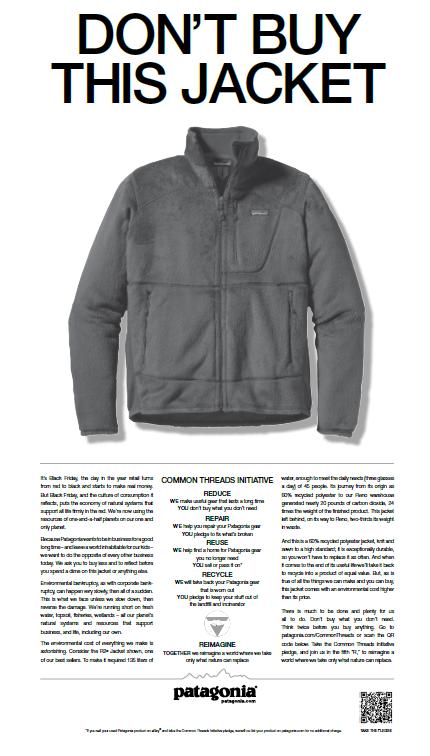
Patagonia advertisement from the Friday, November, 25, 2011 edition of The New York Times
In 2011, Patagonia placed a full-page ad in The New York Times stating: “Don’t Buy This Jacket.” The message is clear: to buy less, repair more, and consume consciously.

Ironically (or not!) the ad helped spike revenue by 30% the following year. But more importantly, it underscored Patagonia’s role as ethical provocateur.
Patagonia has terrific brand authority in ethical manufacturing. This market position is sustained through quite aggressively pursuing its goals. Whether it’s sewing political messages into clothing tags or suing the government to protect national monuments, Patagonia doesn’t shy away from cultural friction. There’s a genuine boldness to this approach. While this may likely alienate some potential customers, it cements the brand as a passionate advocate for the planet.
Ethics, Operations & Circular Design
Patagonia doesn’t just make gear—it repairs it, resells it, and reimagines it. Its Worn Wear program, launched in 2013, encourages customers to trade in used Patagonia gear for store credit, which is then cleaned, repaired, and resold. The brand has also introduced ReCrafted, a collection of one-of-a-kind garments made from salvaged materials that would otherwise be discarded.
Patagonia’s circular design principles are evident in nearly every product line. Over 87% of their apparel is made with recycled materials, including NetPlus®, a fabric derived from discarded fishing nets used in jacket brims and hat bills. Additionally, their Ironclad Guarantee ensures customers can return or repair any item that fails to meet expectations, reinforcing product longevity over fast fashion.
Since 1985, Patagonia has donated 1% of all sales to grassroots environmental groups through 1% for the Planet, which it co-founded.
Patagonia’s focus on closed-loop systems, recyclable fabrics, and carbon-neutral operations reflect Patagonia’s broader circular design strategy.
Digital & Community Engagement
Patagonia’s online strategy is less transactional and more transformational. Its storytelling blends commerce with conservation, from blog posts on microplastics to documentaries on dam removals.
Rather than chasing conversion at all costs, Patagonia leans into values-aligned community building, whether through local activism, user-submitted repair stories, or open calls for climate action.
This integrated model creates loyalty and measurable business value.
Leadership: Simplicity & Stewardship
Chouinard’s leadership style is famously anti-corporate. In his memoir Let My People Go Surfing, he writes:
These quotes resonate beyond the outdoors—they’re touchstones for value-led product development, where function follows philosophy.
Patagonia clothes on hangers. Credit: Robert, stock.adobe.com
Lessons for Ambitious Product Leaders
-
Build mission into the model — Don’t separate purpose from product.
-
Your ownership structure is strategic — Patagonia proves it can be your loudest value signal.
-
Circular economy is a competitive advantage — Repair, reuse, recycle. (Repeat!)
-
Marketing without message is noise — Make your values your volume.
-
Leadership requires restraint — Growth is not always the goal: meaning is. (Growth will follow!)
Conclusion: Success Follows On From Values
Patagonia is a brand, a movement, and a masterclass in aligning commerce with conscience. Its success is not despite its values, but because of them.
At The DaVinci Awards®, we seek to honor this kind of leadership: not only innovative products, but the principles that drive them. Patagonia is proof that doing the right thing can be a strategy rather than a sacrifice.
Patagonia cap. Credit: Максим, stock.adobe.com